
Currently Empty: R0,00



Articles
Are dogs really pack animals? What does the science say?
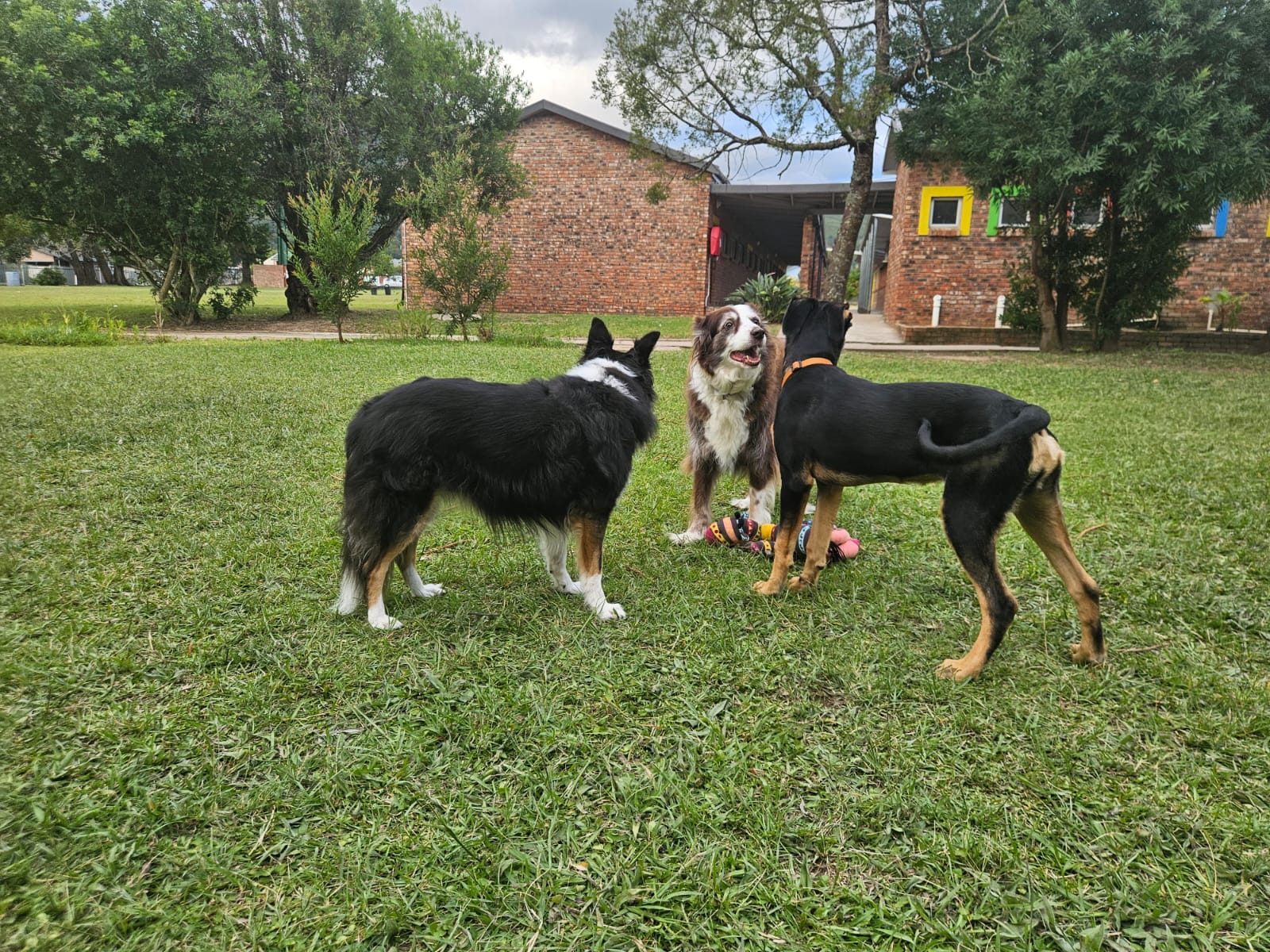
Are Dogs Really Pack Animals?
The claim that domestic dogs are “pack animals” is widely repeated, but it requires careful consideration. In general, the statement is partly accurate: dogs are a social species that can form durable relationships with conspecifics and humans. However, the term “pack” is often used in a more restrictive and problematic sense, implying that dogs are governed by a fixed dominance hierarchy and that human-dog relationships should be structured around the owner’s role as an “alpha” figure. Current behavioural science does not support such a simple interpretation. Domestic dogs are best understood as socially flexible animals whose behaviour is shaped by domestication, ecological context, learning history, attachment processes, health, and individual temperament.
Much of the confusion derives from comparisons with wolves. Domestic dogs and wolves share a common ancestry, and this relationship has often encouraged direct comparisons between canine household behaviour and wolf pack organisation. Earlier interpretations of wolf behaviour, particularly those based on captive groups of unrelated wolves, emphasised intense competition for rank and produced the familiar image of the aggressive “alpha” animal. Later field research on free-living wolves complicated this view. Natural wolf packs are typically family units, consisting of a breeding pair and their offspring. Within such groups, leadership is less a matter of constant coercion than of parental organisation, experience, and reproductive status. This revision in wolf biology is important because it weakens one of the main foundations of dominance-based dog training theory.
It is also necessary to recognise that dogs are not simply diluted wolves. Domestication has altered their morphology, cognition, reproductive patterns, and social behaviour. Wolves generally depend on cooperative hunting, territorial defence, and coordinated pup-rearing. By contrast, many domestic and free-ranging dogs live within human-shaped environments, where survival is often linked to scavenging, opportunistic feeding, and responsiveness to human activity. Social systems evolve in relation to ecological pressures. A canid that hunts large prey in a stable family group faces different selection pressures from one that feeds around settlements, rubbish sites, farms, markets, or human households. For this reason, the wolf pack should not be treated as a direct template for understanding the domestic dog.
Evidence from free-ranging dog populations provides a particularly useful comparison. Such dogs are not confined to pet households, yet they remain closely associated with human environments. Research on urban and village dogs indicates that they may form social groups, but these groupings are often fluid, context-dependent, and less cooperative than wolf packs. Dogs may forage alone, gather temporarily around food sources, associate with familiar individuals, or form loose groups influenced by mating, age, kinship, resource distribution, and local human activity. In this sense, the dog’s social organisation is better described as flexible association rather than obligatory pack living. The distinction matters: a loose social network is not the same as a stable hunting pack organised by a linear hierarchy.
The human-dog relationship further challenges the traditional pack model. Pet dogs do not merely respond to humans as food providers or dominant group members. Studies of dog-human attachment suggest that many dogs use familiar people as a secure base, showing altered exploratory or problem-solving behaviour in the presence of their owner compared with conditions in which the owner is absent or replaced by an unfamiliar person. This points to an attachment-like relationship rather than a simple hierarchy. In everyday terms, a dog that checks in with its owner, seeks proximity in unfamiliar settings, or appears more confident when a familiar person is present may be responding to social security rather than submitting to a pack leader.
The concept of dominance is not useless, but it must be applied with precision. In ethology, dominance usually describes a relationship between individuals in relation to access to particular resources; it is not a general personality trait, nor is it synonymous with aggression, confidence, stubbornness, or disobedience. Domestic dogs may show priority relationships in specific contexts, such as food, resting places, toys, or access to social contact. These relationships can vary across situations and may not form a neat, stable rank order. One dog may be more assertive around food, another around play, and another around resting space. Such variation is better explained through resource value, learning history, emotional state, age, health, and previous experience than through a single household hierarchy.
This distinction has practical consequences. When ordinary behaviours are interpreted through an overextended pack model, owners may misidentify their function. Jumping up may be reinforced greeting behaviour; lead-pulling may reflect arousal, inadequate training, or the dog’s faster natural pace; resource guarding often concerns perceived loss of a valued item; barking may arise from alarm, frustration, excitement, or previous reinforcement. Labelling these behaviours as “dominance” can obscure the actual causes and lead to inappropriate handling. A more scientifically grounded approach asks what antecedents and consequences maintain the behaviour, what emotional state is involved, and what alternative behaviour can be taught.
Domestication has also made dogs unusually responsive to human social cues. Many dogs follow pointing gestures, attend to human routines, and modify their behaviour according to human presence and reinforcement. In free-ranging populations, humans may strongly influence canine social networks by providing food, creating risk, shaping movement patterns, and determining where dogs can safely rest or forage. Consequently, the domestic dog’s social world is often mixed-species. Humans are not external observers of that system; they are often central participants. This mixed-species ecology makes a simple owner-as-pack-leader interpretation too narrow to account for the complexity of domestic dog behaviour.
A further consideration is individual variation. Breed history, early socialisation, developmental experiences, trauma, pain, age, reproductive status, and the current environment can all influence how a dog relates to people and other dogs. Some dogs seek frequent canine contact, while others prefer predictable interaction with a small number of familiar individuals. Some tolerate group walks calmly, while others become stressed in the same setting. If dogs were straightforward pack animals in a rigid sense, this range of social preferences would be difficult to explain. The diversity of domestic dog behaviour instead supports the view that dogs possess social capacities without being constrained to one fixed social structure.
Therefore, the most defensible conclusion is that dogs are social, but not “pack animals” in the outdated alpha-dominance sense. The term may be acceptable if it is used loosely to acknowledge that dogs are relational animals whose social bonds matter. It becomes misleading when it implies that domestic dogs naturally organise their lives around a rigid hierarchy, or that behaviour problems should be resolved by human dominance. A more accurate account recognises dogs as domesticated canids with flexible social strategies, strong capacities for attachment, and behaviour shaped by ecology and learning. This perspective leads to more humane and more effective practice: observe the individual dog, identify the function of behaviour, manage resources thoughtfully, teach alternative responses, and maintain a relationship based on predictability and trust rather than on attempts to imitate an imagined wolf pack.